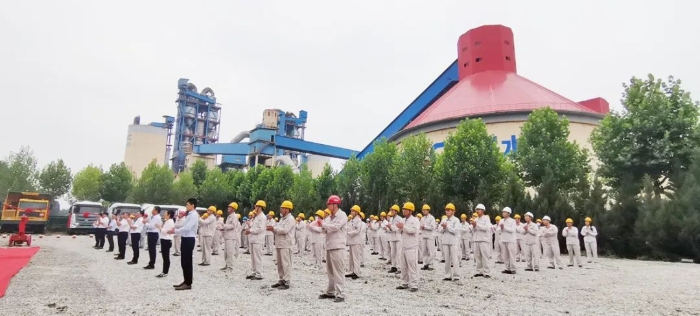

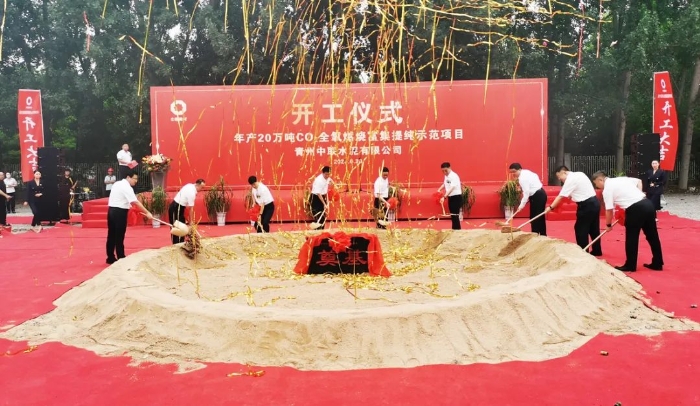
On the morning of June 28th, the” China United Qingzhou Co., Ltd. 200,000-ton-per-year Carbon Dioxide Full Oxygen Combustion Enrichment and Purification Demonstration Project" was successfully launched. This project is currently the largest carbon capture and utilization project in the China’s cement industry, the first of its kind in Shandong Province, and the first cement sector carbon capture and utilization project of China National Building Materials Group. It has been listed as one of the first batch of “open competition mechanism to select the best candidates” projects organized by CBMF and included in the "industry category" project list of the National Development and Reform Commission's low-carbon technology research and development.
The project is a joint effort between Tianjin Cement Industry Design & Research Institute and Shanghai Triumph Energy Conservation Engineering Co., Ltd. with an investment of 256 million yuan. It relies on the 2#production line of Qingzhou Zhonglian and constructs a demonstration line for a 200,000-ton-per-year carbon dioxide cement kiln with full oxygen combustion coupled with low energy consumption carbon capture. The main engineering includes the oxygen production system, carbon dioxide self-enrichment system, carbon dioxide capture and purification system, etc. The oxygen production system adopts pressure swing adsorption oxygen production technology; the carbon dioxide self-enrichment system adopts full oxygen combustion technology; and the carbon dioxide capture and purification system adopts a combination of pressure swing adsorption and adsorption distillation purification technology. The project integrates the most advanced technologies and process equipment internationally and domestically, which can increase the carbon dioxide concentration in flue gas from the conventional 20% to 30% to over 75%, effectively reducing the cost of carbon capture. Compared with conventional chemical absorption methods, the unit cost of carbon dioxide production in this project can be reduced by about 25%. The products can be widely used in industries such as oil recovery, welding, chemical engineering, agriculture, beverages, and cold chain.